 |
|
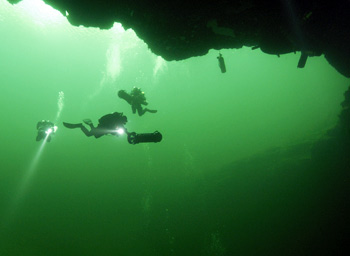
Wakulla Basin, November
2005
|
More photos in the
Wakulla Update photo gallery
Overview (Casey
McKinlay)
I must admit that I was somewhat skeptical about the conditions and
had grown weary of diving Wakulla with horrible visibility, but
that quickly changed as we motored past the B/C junction and into
A-Tunnel with 30-40ft of visibility. The Aug-Oct 2005 work at Chip’s Hole had been a lot of work
and having a few weeks off to catch up seemed the right call, but
with less than 2 inches of rain in Tallahassee since Sept 1 and
clearing conditions we had to take one shot at Wakulla before the
Thanksgiving holiday. The gamble paid off and everyone on site
seemed up to the challenge and glad to be back. Even David Lennon
had a smile on his face and seemed fired up to do whatever it took
on Saturday, November 19.
The plan was fairly basic: the K and
A/K flow meter units had not been transmitting data since the
beginning of the year, so FGS packaged up a replacement unit and
asked the WKPP to transport to K-Tunnel at 4,800ft and swap the
meters. We wanted to limit the request to one meter in case the
replacement did not work, and it turned out to be a data cable
issue; otherwise we would have done the A/K meter as well. While we
were out in the cave, we figured it was also a good opportunity to
begin pulling the safety tanks from 4,800 and 3,500 ft, with team 2
pulling the safety tanks from 2,200 and 1,400ft. In total we
removed 13 tanks for cleanup and recharge. We still have 18 tanks
at 6,500ft but that would have to wait until Dec 3. On Sunday we
took some time out to check some of the sinks in the State Forest
and while they appear to be clearing on the surface, conditions
within the cave have a few more weeks to go..
 |
|
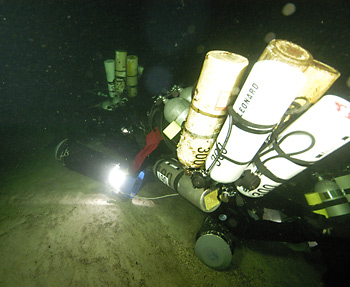
David Lennon hauls old
safety bottles out of Wakulla Springs during the November
event
|
Saturday
Operations kicked off at 8am
Casey McKinlay's Report
The setup crew hit the water early and began placing tanks. Derek
Bennett and Doug Mudry took the lead placing tanks with Shellie
running the surface. Curtis took care of cleaning all the shallow
rock features and bones for the park staff while Anthony Rue took a
hard drive full of photos. David Lennon, Walter Gordon and Scott
Cox handled intermediate support and cleared out the gear while
Mark Messersmith and Jim Miller handled support for the final
surface ascent from the habitat. A lean but extremely efficient
crew with all objectives met.
RB Team 1 (Koritz, McKinlay, Rose) transported the replacement
Falmouth Scientific meter 4,800ft to K-Tunnel. Terry and John
unpacked the replacement meter, disconnected and removed the
malfunctioning meter, installed the replacement meter and packaged
up the malfunctioning meter for delivery to the door. Watching
Terry and John operate seamlessly at a depth of 265ft almost 1 mile
back in Wakulla came as no surprise. The entire switch took less
than 20 minutes and FGS confirmed the new meter was active and
transmitting on Monday morning. As Terry and John wrapped up the
meter work I grabbed the 4 safety tanks at 4,800ft for delivery
back to the surface for recharge and reg overhauls. John stopped at
3,500ft on the exit and grabbed the 3 safety tanks to complete the
mission. Total bottom time was 85 minutes.
 |
|
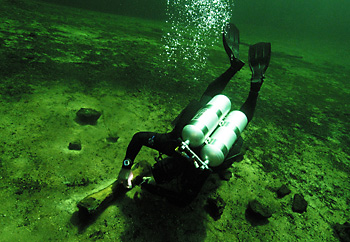
Curtis Baldwin cleans the
mastadon bones in the Wakulla basin
|
RB Team 2 (Garland and
Leonard)
Todd Leonard’s report
After seeing the first team off and allowing a short head start,
our dive got underway at 11:13am with a mission to retrieve old
safety bottles from 2200 (A/D junction) and 1400. Each of us was
diving an RB-80 rebreather, carrying two scooters, two 300 drive
bottles, and a 190 deco bottle.
We plugged in our 190 bottles, and deployed the 190 open-circuit
reg for the initial descent (to avoid any possibility of hypoxia
while we slowly worked our way through the hydrilla). We paused at
30ft to switch to the breathers, checked the habitats to confirm
our deco and break gas were placed correctly, and began our descent
into the cave. Working our way out A tunnel, we passed the A/B/C
junction. As we approached 1400 the line we were following went to
the ceiling where we found the safeties we'd be pulling later. A
hundred feet or so later the line crossed another line, so we
dropped an arrow to indicate which one would lead us to the
safeties -- better to take a moment now than potentially waste
minutes later backtracking. We continued into A tunnel until
reaching the A/D junction. We could feel the change in water
temperature and see the clear/tannic mixing. We noted the batch of
safeties a short distance to our left. We paused to switch scooters
on return to the A/D junction, then moved to the safety bottles. We
divided and hip-clipped the three safeties, then began our exit.
Back at 1400, we again divided and hip-clipped the safeties, giving
us three each. With 64 minutes on the clock, we slowed our ascent
at 240... a bottom time of 51 minutes. The photo team met us soon
after the switch, and support divers arrived shortly thereafter to
pull our scooters, drive bottles, and the safeties. All in all, a
very enjoyable day. Max depth 291fsw, bottom time 51min, run time
324min.
The support team had everyone packed up and on their way to dinner
by 8pm
Sunday
The WKPP did some field recon in several of the sinks in the
Wakulla Springs State Forest and Apalachicola National Forest to
assess to what degree conditions upstream were improving. We put 1
team in the water to check flow and visibility and 1 team on the
surface to hike and photograph various sinks. Conditions appear to
be clearing but are not quite clear enough.
We will prepare for Dec 3-4 and Dec 17-18 to finish the meter
repairs and rotate the safety tanks all the way out to 6,500ft. In
total, we have close to 33 safety tanks in Wakulla that need to be
rotated from the 2003 effort. If we can wrap this up ahead of the
holidays, we should be well positioned to hit it hard in January
– February. Thanks again for all the hard work this past
weekend and looking forward to a productive 2006. This could be the
beginning of a good and long overdue run for the project.
 |
|
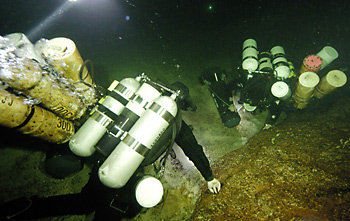
Todd Leonard and Mark
Garland return with safety bottles to be rotated out of the
system
|
Next: December 3-4,
2005
|
Project made possible through the support of:


|